
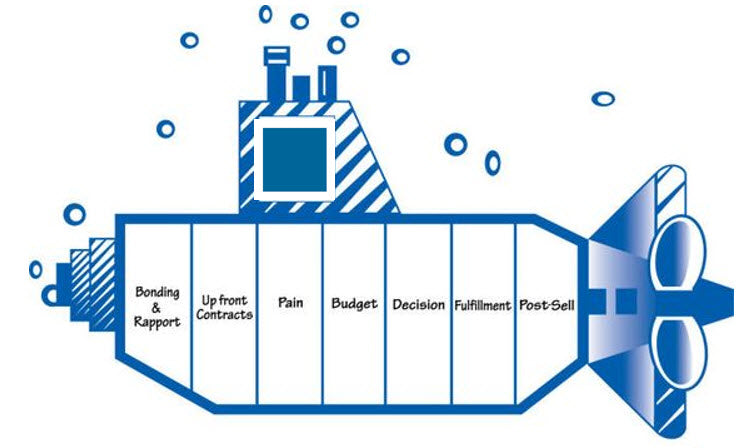
One of the most recognizable visuals in my office is the Sandler Submarine diagram. Even years later, it remains one of the best representations of a disciplined sales process and one of the most searched topics on our website.
The concept is simple but powerful.
When submarines were under attack, crews had to move carefully through each compartment of the vessel, sealing the previous door behind them to prevent flooding and protect the submarine from disaster. The Sandler Selling System uses this same concept as a framework for successful sales conversations.
Instead of jumping ahead, chasing unqualified opportunities, or rushing into presentations too early, sales professionals move methodically through each compartment of the process. Each step builds on the previous one, helping avoid wasted time, stalled deals, and costly mistakes.
The goal is not simply to “make the sale.” The goal is to guide the right prospect through a structured process that leads to a successful outcome for both sides.
Compartment 1: Bonding & Rapport
Every successful sales relationship starts with trust.
The Bonding & Rapport stage is where you establish a genuine connection with the prospect and create a comfortable environment for open communication. People buy from those they trust, and trust is built through authenticity, listening, and understanding.
This is not about small talk for the sake of small talk. It is about creating enough comfort and credibility to allow for honest business conversations.
Compartment 2: Up-Front Contracts
This is one of the most unique and valuable concepts in the Sandler system.
An Up-Front Contract establishes clear expectations for the conversation before it begins. Both parties agree on the purpose of the meeting, the agenda, timing, next steps, and possible outcomes.
Without clear expectations, sales conversations often drift, meetings become unproductive, and follow-up turns into guesswork.
Strong Up-Front Contracts create alignment and accountability from the start.
Compartments 3–5: Pain, Budget & Decision
These three compartments represent the qualification stage of the sales process.
Pain
This is where you uncover the prospect’s real challenges, frustrations, and business impact. If there is no meaningful pain, there is usually no urgency to change.
Budget
Once the problem is clear, you determine whether the prospect has the financial resources and willingness to invest in solving it.
Decision
Finally, you identify how decisions are made, who is involved, what the timeline looks like, and what obstacles may exist.
Too many salespeople skip or rush through these stages and end up presenting solutions to prospects who are not qualified, not ready, or not aligned internally.
The Sandler Submarine prevents that.
Compartment 6: Fulfillment
Only after the previous compartments are completed should the presentation or solution discussion begin.
At this stage, you position your product or service specifically around the prospect’s stated pain points, goals, budget, and decision process.
The presentation becomes highly relevant because it is based on information the prospect already shared, not on assumptions.
This creates stronger alignment and significantly improves the likelihood of closing the sale.
Compartment 7: Post-Sell
The process does not end once the agreement is signed.
The Post-Sell compartment focuses on reinforcing the buying decision, addressing any lingering concerns, preventing buyer’s remorse, and laying the groundwork for referrals and future business.
This stage is often overlooked, but it can have a major impact on long-term customer retention and relationship growth.
Why the Sandler Submarine Still Matters Today
Modern sales tools, automation, CRMs, and AI platforms have changed how we communicate, but they have not changed the fundamentals of human decision-making.
The Sandler Submarine remains relevant because it provides a structured, repeatable framework for navigating complex sales conversations with confidence and discipline.
It helps sales professionals:
- Qualify opportunities more effectively
- Avoid chasing poor-fit prospects
- Create clearer communication
- Improve closing consistency
- Build stronger long-term relationships
Most importantly, it helps salespeople know when to move forward and when to close the file.
That discipline is often the difference between a productive pipeline and a flooded submarine.